
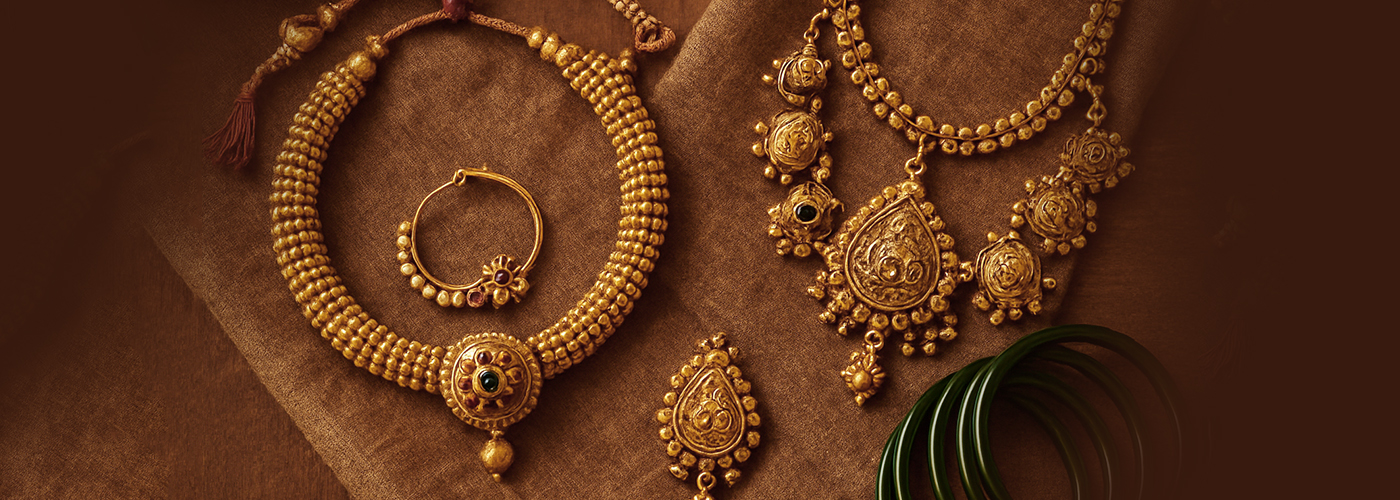
The beauty of a Maharashtrian bride lies in the intricate details of her ornaments, each carrying a name that reflects nature, royalty, or spiritual devotion. For over a century, Waman Hari Pethe Sons has been the custodian of these names, ensuring that the legacy of traditional Marathi jewellery remains as vibrant today as it was during the era of the Peshwas.
Whether you are building your bridal trousseau or looking for a meaningful gift, understanding these names is the first step toward appreciating the rich cultural tapestry of Maharashtra.
1. The Iconic Neckpieces: Thushi and Kolhapuri Saaj
No list of traditional gold jewellery is complete without the Thushi. It is a choker made of closely woven gold beads, symbolizing that the wearer’s home will always be blessed with food and prosperity. Another legendary name is the Kolhapuri Saaj. Comprising 21 unique pendants (including motifs of the sun, moon, and the ten avatars of Lord Vishnu), it is more than a necklace—it is a sacred amulet of protection and an essential family heirloom.
2. The Graceful Naths: Brahmani and Peshwai
The Nath is the most distinctive element of a Marathi woman’s ensemble. The Brahmani Nath is typically adorned with Basra pearls and a single red stone, shaped in a classic paisley curve. For those seeking more grandeur, the Peshwai Nath offers a larger, more elaborate design often encrusted with diamonds. Wearing a Nath from Waman Hari Pethe Sons is a mark of cultural pride, instantly elevating any bridal look with “old-world charm.”
3. Sacred Symbols: Mangalsutra and Tanmani
The Mangalsutra is the ultimate symbol of marital commitment, traditionally featuring two gold vatis (inverted cups) that represent the union of two families. While many now opt for a short mangalsutra for daily wear, the sentiment remains eternal. Another essential name is the Tanmani—a regal pearl choker with a grand, stone-studded central pendant. It is the epitome of heritage jewellery, often worn to signify the grace and status of the household.
4. Wrist and Arm Adornments: Tode, Patlya, and Vaaki
Maharashtrian bangles are unique in their structure. Tode are thick, intricately carved gold kadas interlinked without soldering, while Patlya are broad, flat gold bangles with delicate engravings. These are traditionally worn alongside green glass bangles to signify fertility. On the upper arm, the bride wears the Vaaki (armlet), a sacred emblem of feminine power and protection, making it a standout piece of handcrafted gold jewellery.
5. Finishing Touches: Bugadi, Ambada, and Jodvi
The smaller details often carry the most history. The Bugadi is a delicate ornament worn on the helix (upper ear), typically featuring pearls and rubies. For the hair, the Ambada (or Veni Phool) is a crescent-shaped gold pin that adorns the bun. Finally, the Jodvi—silver toe rings gifted by the mother-in-law—symbolizes the bride’s entry into her new home. Each of these traditional Marathi jewellery pieces ensures that the bride is adorned with blessings from head to toe.
Explore the Legacy at Waman Hari Pethe Sons
At Waman Hari Pethe Sons, we don’t just sell jewellery; we preserve names, stories, and traditions. Visit any of our store to explore our extensive range of certified gold jewellery, from the majestic Rani Haar to the minimalist gold pendant set. Whether you are looking for a long mangalsutra or a contemporary diamond locket, let our experts guide you through the beautiful vocabulary of Maharashtrian heritage.
